Sunday, February 21, 2010

Can dolphins help with diabetics?

New research has added to the fact that bottlenose dolphins go into a safe diabetic state during their overnight fasting. This results in maintaining high levels of glucose in their blood. On February 18th, at the annual meeting of the American Association for the Advancement of Science, more research was presented suggesting that dolphins could be a good model for studying and experimenting with for diabetes. It could provide greater understanding and results for people living with the disease as well. Carbohydrates usually give animals a large amount of glucose. What dolphins eat cause them to have a lot of protein and not so much glucose-rich carbohydrates. It is possible that dolphins have something called a "diabetic switch" which gives them food even when they do not eat. Veterinary epidemiologist Stephanie Venn-Watson said "Brains need sugar to function, but a diet of fish has no sugar". This believed in "switch" could possibly enable dolphins to control their diabetic state. A person with type 2 diabetes has high levels of glucose when they are resistant to insulin. They do not respond to the insulin, which tells their body tissues to soak up the glucose from in the blood. Dolphins, however, are a different case altogether. When a person has a high level of glucose it can prove to be hazardous, but for a dolphin it might help fuel their big brains when they are in between meal times.

Studies show that this "insulin resistance" that dolphins have can be bad. The insulin level in something is when cells in the liver, muscles, and fat tissue take glucose from the blood and keep it in the liver and muscles. From this resistance the dolphins could start to produce a "pathological form of diabetes," meaning there is no way for the diabetes to go away, and they cannot control it. For weeks scientists worked to study dolphin's insulin levels. They did this after each dolphin ate, and they studied six dolphins. They found that when dolphins fast, they "show changes in blood chemistry" and they also have changes in their glucose level, which is exactly like humans. Humans and dolphins are very different, but we both have big brains and large blood cells which can carry big amounts of glucose. Some scientists believe that humans have a similar "switch," like the dolphins, in our bodies. Scientists believe that after the ice age, humans could not eat carbs because all the foods with carbs froze. So, they believe that humans used this "insulin resistance" to keep glucose in the brain. They believe something similar to this happened to the dolphins many years ago. In conclusion, scientists think and hope that maybe they could find a diabetic "switch" in humans.


By, Raina, Irena, and Aliza

Friday, February 19, 2010


Attacking Cancer Cells With Hydrogel Nanoparticles

Researchers at the Georgia Institute of Technology have found a new way to aid chemotherapy and lessen the dramatic effects it has on the body. They are using special apoptosis causing RNA (siRNA) to kill cells in the specific area where the cancer is. Therefore, this procedure can target just the cancerours cells and not kill non-cancerous cells like chemotherapy does. This newly discovered type of siRNA does not totally do the job of chemotherapy, but it can make chemotherapy more effective and therefore lessen the time chemotherapy is actually used. This siRNA inhibits the EGFR’s (Epidermal growth factor receptors). In cancerous cells there is an overabundance of EGFR, which causes cells to go through mitosis faster and more often, and it also inhibits the cells apoptotic function. By interfering with the EGFR, siRNA allows the cell to regain its apoptotic function and also stop the constant reproduction of new mutated, cancerous cells.

The siRNA cannot survive outside of the cell very long, since it denaturalizes. However, the researchers have also found a hydrogel that keeps the siRNA intact outside the cells and therefore can be safely transported into the cancerous cells. The hydrogel does another, more important job. If the siRNA is only released at one time the cancerous cell can recover its control over the EGFR and therefore the treatment would be ineffective. However, the hydrogel releases the siRNA slowly and constantly over a period of time, which allows the cell to either go through apoptosis or for the chemotherapy to kill the cell.


Works Cited:
http://www.medgadget.com/archives/img/sirna.jpg

http://www.sciencedaily.com/releases/2010/02/100216140404.htm?utm_source=feedburner&utm_medium=feed&utm_campaign=Feed%3A+sciencedaily+(ScienceDaily%3A+Latest+Science+News)&utm_content=Netvibes

http://www.odec.ca/projects/2005/thog5n0/public_html/Tumour.gif

Wednesday, February 10, 2010

Malaria Vaccine

Malaria is a very serious disease. It is spread by infected mosquitoes who bite a contaminated person and then pass on the disease when they bite another, uninfected person. Once bitten by an infected mosquito, the victim gets the malaria parasite in their blood stream. Once in the blood stream, the parasite begins to multiply and spread all over the body and disease and/or death soon follow. According to the World Health Organization, there are over 300 million cases or malaria each year, and every 30 seconds a child dies from malaria – that means that almost 1 million children die every year from malaria alone. Scientifically, we can treat malaria and keep the disease from being effective, but it is expensive and malaria has been eradicated in the developed world, which have prevented research into making the medication less expensive. However, in developing places like Africa, because the treatment is too expensive and there is no vaccine, the way to prevent the disease was to sleep under mosquito nets or to kill the mosquitoes. However, these are bad solutions because the only thing that is truly effective against mosquitoes is DEET, but when released upon an environment in large, blanketing quantities, it negatively affects many different parts of the ecosystems – and it is impossible to stay under a mosquito net every moment of every day. Although by adulthood most people in malaria affected nations have developed some sort of immunity, the high death rate among children has prompted a wide spread search for a vaccine.

And, it appears that one may have been found. Called FMP2.1/ASO2A, this vaccine targets the falciparum malaria strain, the most common and deadliest strain. How it works, is a protein, called AMA-1 affects the virus and causes it to be ineffective or makes it easier for the immune system to defeat – the exact mechanism was not explained. In addition to this protein, an adjuvant system, called ASO2, is utilized to increase immune system response so the immune system is more likely, and better able, to produce the antibodies that will fight of later infections. The vaccine is currently being used tested on a larger scale, from 100 children to 400 children and thus far there have been no adverse effects.

There are, however, some problems with this vaccine. First, it treats only one specific strain. While this is a big step, and researchers are hopeful it will be effective against other strains, these other strains are killing people as well and this vaccine may not help them. Also, malaria is a parasite, which means it does not behave like a disease caused by a virus or bacterium. Unlike many of these diseases, when symptoms of malaria abate, the parasite is still in the victim’s body and relapses occur. What happens to people who survive the first time, is their immune system develops an immunity to the disease which lessens the severity of these relapses. Decreasing the severity of the relapses is what this vaccine attempts to duplicate. The problem with this approach, is that if the parasite is genetically altered in anyway, it is still in the victims body and the changes will affect the victim immediately, rather than on the off chance they get bitten by a mosquito with the altered parasite.

University of Maryland Medical Center. "New Malaria Vaccine Is Safe and Protective in Children, Scientists Find." ScienceDaily 6 February 2010. 10 February 2010 .


Monday, February 8, 2010

Health Benefits from Vitamin D?

By Jennie, Sophie, and Zoe
Original Article Here

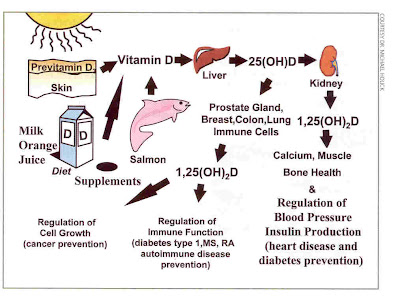
Some scientists believe that vitamin D could be used to build bones, strengthen the immune system, and lower the risk of illnesses such as diabetes, heart and kidney disease, high blood pressure, and cancer. They think that people can achieve this by consuming more vitamin D that the body makes from sunlight, fish, and fortified milk. Vitamin D is found throughout the body and it is used to turn cells on and off.People’s vitamin D levels are influenced by whether they have light or dark skin, where they live, how much time they spend outdoors and by fish and milk consumption. To raise one's vitamin D level without taking an actual supplement, you could increase the time you get sun for 15 extra minuets. People who are older, have diabetes, kidney disease, or stay indoors are at risk of Vitamin D deficiency.The recommended amount of consumption is 400 international units a day. but for many that could be too low. Although many people don't get the recommended amount of vitamin D. The 2008 on an American Journal of Clinical Nutrition showed that 10% of children are very deficient of Vitamin D. Now many doctors check their patients to see if they are getting a recomended amount of vitamins and prescribe them medicine if they aren't. Although some scientists are skeptical about the idea that vitamin D can b used to help so many problems. They are not positive that it will help improve health for everyone or if it could even have negative effects on some people. Also they are afraid of people consuming high doses and having bad side effects. The type of experiment scientists would have to do to be able to test Vitamin D would involve using humans as test subjects which is morally wrong if they humans have bad side effects. Dr. Manson says that it is possible for people to have high levels of vitamin D if they exercise or stay outdoors a lot of if they have a healthy diet and don't smoke. The nationwide clinical trial is taking 2,000 adults such as men 60 years older and women 65 and older to study if high doses and amounts of vitamin D and omega 3 fatty acids from things such as fish oil can help lower the probability of heart diseases and cancer. Dr. Manson's experiment is to take the participants and divide them into four separate. 1 group will take vitamin D and fish oil pills, 1 will just take vitamin D, 1 will just take fish oil pills and the 1 will take placebo pills. the participants will take vitamin D3 and will use one-gram supplements of omega-3 fish oil. They will take it about 5-10 times of the average daily intake.
The Women's Health Initiative study tracked women taking 400 units of Vitamin D and 100 units of calcium. Although they didn't find many benefits to taking the supplements except a lower risk of hip fracture. Also many people believe that 400 units isn't enough but every person varies. Another study was for 1,200 women who took 1,500 milligrams of calcium and 1,000 units of vitamin D and they showed a lower risk of breast cancer. Although vitamin D and calcium might have a positive effect, some scientists even say that increasing the supplements can cause heart problems, diabetes, and cancer. Other scientists say its hard to predict the potential effects a person could have.

Acknowledgments:


Reblog this post [with Zemanta]

Sunday, February 7, 2010

Will Genetic Juicing Replace Steroids?


Athletes are always under pressure to become stronger and faster. Some coaches take risks and drastic measures like steroids. Many athletes and coaches will be tempted to find new ways to give the athletes and advantage. Thus, many people are now turning to Gene therapy to make themselves stronger. Gene therapy is the practice of inserting different genes into the cells to improve their performance. Currently, it is only legally used for medical reasons to make patients live longer. However, gene therapy is currently risky for several reasons: firstly, the gene may be rejected by patient. Because the genes are foreign material, people's immune system may reject the gene and destroy it, causing the operation to fail. If the operation is done poorly enough, the immune system's response may be severe enough to kill the patient (i.e., shutting down organs, including the brain). Also, gene therapy does not last for a long period of time, so multiple operations are required until the therapy actually works and cures the patient.

This does not stop many athletes and coaches attempting to try it out. Many medical centers claim to have the latest "breakthrough" in genetic therapy, and they claim to be cheap and effective. One of the more popular advertised therapies is the insertion of synthetic genes into athletes, which can produce chemicals linked to muscle building. Another molecular manipulation regulates or increases the production of energy-efficient muscle fibers. In 2006, a German track and field coach tried to allow genetic juicing to his athletes for the 2008 Olympics in China, but was caught before anyone could be treated. In an attempt to stop genetic manipulation in athletics, the World Anti-Doping Agency (an organization set up by the Olympics to stop athletes from using enhancing drugs in sport) preemptively outlawed all genetic therapy in athletes. Additionally, scientists are working on ways to catch genetic enhancements by looking at and isolating suspicious genes. Sadly, these preventive methods will probably to do little to stop desperate coaches and players, and genetic enhancements in athletes may replace steroids. However, the side effects of genetic therapy are much more dangerous than steroids, and they will probably lead many players to their demise.


Sea slugs that are half plant, half animal

Sea Slug
A green sea slug was found that seems to be part animal, and part plant. It is the first animal to produce the plant pigment Chlorophyll. The slugs seem to have taken some of the genes from algae that they eat. With these stolen genes, they can carry out photosynthesis. The slugs can make their own energy without having to eat. This of course is very beneficial when it comes to survival. Sidney Pierce studied these green sea slugs, called Elysia Chlorotica for around 20 years. January Seventh was the first time that multicellular animals produced chlorophyll. The sea slugs live in the salt marshes in New England and Canada. They take the genes needed to make the green chlorophyll and the small cell parts called chloroplasts which are used to conduct photosynthesis. The scientists doubted this, so they designed an experiment. In the experiment, the researchers collected them, and put them in a tank without any food. As long as the sea slugs had light on them for 12 hours a day, the slugs could survive. The researchers used a radioactive tracer to make sure that the slugs were actually producing the chlorophyll and not stealing from algae. They actually pass it on to future generations. The babies of the sea slug theives can produce their own chlorophyll, but they can't produce photosynthesis until they've eaten enough algae to steal the necessary chloroplasts. Scientists aren't quite sure how the slugs can actually take the genes that they need. It is obvious that they take DNA from other organisms, but the mechanics are still unknown.

Tuesday, February 2, 2010

Researchers find "broad spectrum" antiviral that fights multitude of viruses

One of the reasons viruses are near impossible to combat is the fact that not only do they vary in many ways but they mutate often. Deadly viruses such as HIV are able to resist so much of what is thrown at them because of their mutating abilities. Despite the mercurial nature of viruses a group of researchers from UCLA and other universities may have found an effective way to combat them.

The compound the researchers have discovered is a rhodanine derivative that the researchers have dubbed LJ001. It is classified as a “small molecule broad spectrum antiviral”, meaning that it fights viruses by attacking them through a common feature that viruses share. LJ001 works by binding to both cellular and viral membranes and inactivating them. However LJ001 is not harmful because of the natural regenerative qualities of metabolically active cells which are able to repair the damage unlike the virus cell. Therefore the compound is able to attack viruses without serious damage to the rest of an organisms’ cells. Researchers have seen the effectiveness of LJ001 on various virus strains however the exact mechanism if viral membrane inactivation is still unknown

One of the reasons for excitement over LJ001 is the fact that the FDA has approved few broad spectrum antivvirals, and the ones that have generally less effective and very costly. Studies have shown that LJ001 has the potential to be effective against a wide range of viruses HIV-1, influenza A, filoviruses, poxviruses, arenaviruses, bunyaviruses, paramyxoviruses and flaviviruses. These viruses are the cause of some of world’s deadliest diseases such as, Nipah virus encephalitis, Ebola, hemorrhagic fever and Rift Valley fever. Since it is a broad spectrum antiviral, LJ001 may even have the properties to be effective against viruses that have yet to be discovered.

Rivero, Enrique. "Researchers find 'broad spectrum' antiviral that fights multitude of viruses."www.eurekalert.org. 01/02/2010. Eurekalert, Web. 2 Feb 2010. .


-Jukie & Cyrus